Wednesday, 1 November 2017

MAY THEY REST IN PEACE


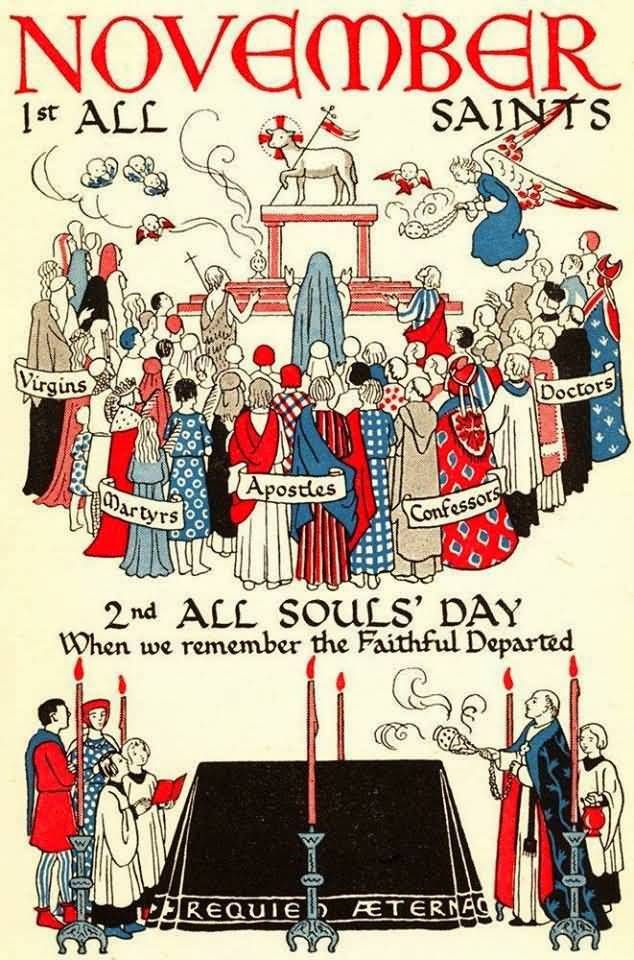
The Holy Souls in purgatory, Angels, and saints adoring Jesus in the Most Holy Sacrament of the Altar.
HOMILY FOR THE SOLEMNITY OF ALL SOULS
Rev. Fr. Ezekoka Peter Onyekachi

Whenever we talk about the Holy Mother Church, we do not only talk about those living on earth and practicing their faith. There are three groups that make up the Christian Church: the Church Militant, the Church Triumphant, and the Church Penitent. The first consist of Christians on earth who struggle as soldiers of Christ against sin and the devil. The second consists of those who have the beatific vision and are now in heaven. The third (which is our interest for the purpose of today’s solemnity) which can be variously called the ‘Church suffering’ or the ‘Church expectant’ consists of those who are in purgatory undergoing purification. They are there to satisfy whatever portion of the temporal punishment due for their sins that was not satisfied before death. They are in the process of purging their imperfections before their eternal beatific vision. The truth is that they all are destined for heaven; that is, to join the Church triumphant. It is the members of this third group that we remember today. So, All Souls day commemorates the Holy Souls of Christians who have died but are yet to enter heaven. It is a day we remember the souls of all our brothers and sisters who were with us not quite long time ago and now are no longer with us in this our human struggle. We pray that they rest in peace. Only in God can we really say that souls have rested in peace. Where they are now, they are still restless; restless because of their constant desire to see God face to face.

Hope does not disappoint. With these words, the second Reading (Rom. 5:5-11) encourages us and at same time reminds us that Christ has paid the full price of our redemption through his blood. Hence, inasmuch as these brethren of ours died with Christ in their baptism, believed in Him and lived according to his precepts, we are sure that they will be saved. The Christian hope can never be illusive because it is founded on God. When our hope is in God, it cannot turn to dust and ashes. Our hope can never disappoint us because God has given us the final proof of his love. Through Jesus, our status with God got changed. This status that changed is our justification. But not only did our status change; our state also got changed. This state that changed is our sanctification. Justification ensures that we are no longer slaves to sin. Our faith in our Lord Jesus has liberated us from the chains of the evil one. But we need to work on this justification, but to do this, we still need Jesus. The process of his intervention to ensure the maintenance of our justification is sanctification. Was it not Jesus himself who tells us in the Gospel of today (John 6:37-40) that he will never turn away anyone who comes to him? The will of God is that none of us should be lost, but be saved. If we believe in Jesus and do his will, we shall have eternal life.  

Sanctification is a process which starts on earth but does not stop until we behold the beatific vision. Hence, it is Jesus who continues to ensure that our brethren in purgatory are sanctified more and more and more until they are fully sanctified and perfected for heaven. Indeed, the existence of Purgatory is a great manifestation of God’s love for humans. He does not want us to be damned. He desires our salvation. The belief in the concept of purgatory is traceable to the third Century, but the Church did not give it the status of official teaching until the Second Council of Lyons in the 13th century in 1274. This Council had the desire to restore unity between the Western and the Eastern Churches; part of the discussions attempted to reconcile the beliefs of the two Churches concerning the status of the dead, especially the lot of repentant sinners. This effort continued at the Council of Flourence (1438-1439); and again the subject of a post-death process of purification for sinners came up in the discussions. Even though the effort to reunify the Churches failed, the Council defined Purgatory as an official teaching of the Catholic Church. It was furthered defined at the Council of Trent (1563).

To get the Church’s teaching on purgatory, it is clearly summarized in the Catechism of the Catholic Church: all who die in God’s grace and friendship, but still imperfectly purified, are indeed assured of their eternal salvation; but after death they undergo purification so as to achieve the holiness necessary to enter the joys of heaven (CCC, 1030). The Church gives the name purgatory to this final purification of the elect, which is entirely different from the punishment of the damned. Simply put, the doctrine of Purgatory has three components:
1) That purification after death exists
2) That it involves some kind of pain
3) That the purification of the dead can be assisted by the prayers and offering of the living

It is true that no one can say that there is a commandment in the Bible which states that we must pray for the faithful departed. We must also know that there is none which tells us never to pray for them. However, the Bible tells us about the practice of people who prayed for their dead. In 2 Mac 12:38-42, we are told of the story of Judas who made a collection of money and sent it to Jerusalem to offer as expiatory sacrifice for the souls of the soldiers who died during the battle against Gorgias; and afterwards in 2 Mac. 12:43, we are told that this act of Judas is a noble and excellent one.  In Sirach 7:33, we are admonished to be generous with the living and not to withhold our kindness from the dead. Therefore, my dear friends, do not forget to pray for your dear ones who have gone before us to answer the call of faith. May their souls rest in peace. Amen. God bless you.

Tuesday, 31 October 2017

THOSE MARKED WITH THE SEAL


HOMILY FOR THE SOLEMNITY OF ALL SAINTS
November 1st All Saints Day Clipart Greeting Ecard
Rev. Fr. Ezekoka Peter Onyekachi

Today, we celebrate the Solemnity of All Saints. It is a feast that reminds us of the need for identification. Identification is a major sign that denotes belongingness. Many, if not all of the human society have something with which her members are identified. Schools have badges, stamps, logo, motto, uniforms, etc. Companies have their trademarks. Countries have their flags and coat of arms. There are some images that imprint unto our mind the existence of a particular group or society. These signs, images, trademarks are seals that help to authenticate membership in these organization. Many times, these signs are used to denote the visions and the mission of the said group.

Take for instance, the Great Seal of the Americans that has been in use since 1782 (325 years ago) is a major mark used to authenticate certain documents issued by the United States Federal Government. The crest is a glory or breaking through a cloud proper, surrounding an azure (blue) field bearing a constellation of thirteen stars argent (silver platform/metal). In it is the image of a bald eagle, bearing in its dexter (right) talon an olive branch, in its sinister (left) talon thirteen arrows, and in its beak the scroll bearing the motto: E Pluribus Unum (one out of many). In its reverse is another motto: Annuit coeptis (He has favoured our undertakings) and Novus ordo Seclorum (New world order). The reverse also bears an unfinished pyramid; in the peak is an eye in a triangle surrounded by glory. This great seal captures the major vision of the American Society. it is used for identification of certain documents such as the American passport, military insignia, embassy placards and various flags.

The First Reading (Rev. 7:2-4, 9-14) talks about the greatest of all the seal, the seal of the heaven citizenry. Every great seal denotes membership. It reminds the members of their vision and it is an insignia for authentication. God will give the command. That command will be to delay the judgments of the great tribulation until all the saints are sealed. The seal here means the mark of possession/ownership, authority, power, protection and preservation. In ancient times, a king’s ring was his seal. He would stamp the mark of his ring on all official documents showing their possession, authority and power. This is certainly one of the meanings the seal in the first reading bears.

In Genesis 41:42, Pharaoh took his ring and put it on Joseph’s hand as a sign of power and authority (cf. Also Esther 3:10, 8:2). In the case of Daniel, King Darius confirmed his proclamation after the divine liberty of Daniel from the den with his signet ring marked on the stone that was laid on the mouth of the den (Dan. 6:17). The number of those marked with this seal is numbered 144, 000. How? The number, 144, 000 does not denote strictly a numerical populace for heaven. It denotes completeness and perfection, and not limitation. It is made up of 12 multiplied by 12 –the perfect square; and being rendered more inclusive and complete by being multiplied by 1,000. These numbers tells us that the number of those to be saved will be great, not small.

In the New Testament, the Christian is sealed with the spirit of God; that is the Holy Spirit. The Holy Spirit guarantees that we belong to God. The presence of the Holy Spirit in the life of the believer is his seal and his guarantee that he will escape the judgment of God so as to live eternally with God. It is a life of blessedness. It is God who has put his seal on us and given us his spirit in our hearts as a guarantee (2 Cor. 1:22). In John’s vision in the First Reading, these men who have been marked with the greatest seal together with the angels praised God and sang to his honour. John was amazed at the sight of these men. One of the elders went to him and asked John who the countless people are. They were clothed in white robes. They have lived a life of blessedness while on earth (cf. The Gospel, Mathew 5: 10-12). They are the men who have come out from the great tribulation because they had the mark of the greatest seal. They have washed their robes in the blood of the lamb and thus have made them white.

The picture of robes made white by being washed in the blood of the lamb is paradoxical. This paradox can be a way of saying that this victory and purity were won in the power and at the cost of all Jesus did for men in his life and death. They are martyrs who have given up their lives for the sake of Christ. The clothing of all believers colours white, which stands for purity and perfection. It means that the person has no spot of sin, evil or corruption in him. When the Bible speaks about the blood of Jesus Christ, it speaks not only about death but also about his life and death. The blood of Christ stands for all the redemptive acts of Christ in his life and deeds. The blood of Christ cleanses all sins (1 John 1:7) and redeems us (Ephesians 1:7).

The desire of every one of us is to be among these saints that are in white robes. It is the wish of every Christian. To be counted as one, we need to live the life of blessedness. It will be pitiable if our names are lost to Sheol in death after we have lived luxuriously on earth. We need to be in the great number of saints that are marching on and singing honourable hymns to our God. The feast of All Saints reminds all of us of our double citizenship and of the need to struggle that we become citizens of both. May we be reinvigorated for a life worthy of sainthood. Amen. God bless you.

Friday, 27 October 2017

YOU SHALL NOT MOLEST OR OPPRESS AN ALIEN


HOMILY FOR THE 30TH SUNDAY IN ORDINARY TIME, YEAR A
Rev. Fr. Ezekoka Peter Onyekachi

A woman had told the story of how a man she called her husband molested her. It started with the man beating and insulting her, and telling her she had nowhere else to go. It came in the form of drugs he introduced to her and supplied her with to keep her from getting sick. Whenever he wants to force the woman to go against her own will, he would withhold the drugs until he got what he wanted. He constantly talked to her in a manner that made her constantly lose her self-esteem. She had a son who was got out of wedlock, and who the woman had tried not to disclose her past she considered shameful. This man would always threaten his wife whom he molested with this secret that if she resists him in whatever means he would disclose it to the boy; and that was the last thing the wife wanted. She had no one to lean on. She kept on managing.

The man also physically abused this young boy that he wondered if really he was his father. Due to the woman’s character which she swore to protect, she managed and covered these misdemeanours. This man would always portray himself to visitors as a quiet and gentle man that no one thought of him in that direction. These happenings led the boy to several suicidal attempts as a result of his health. He was diagnosed as having lobe epilepsy as a result of the trauma in the hands of his father. When the woman saw that she was about to lose her son, she was pushed to seek for help. She went out of herself, disregarding the shame she always had, disregarding the name she always protected, and went to a spiritual director and counsellor. She encountered God and her life and the Son’s life changed for good. Surely, the man had to face the law. How often do we suffer because we are silent, silenced by many forces, silenced by empty threats, silenced by the fear of the unknown and the fear of shame?

The First Reading (Exod. 22:20-26) of today starts with a clear assertive statement: you shall not molest or oppress an alien? It continued: you shall not wrong any widow or orphan. The question becomes: who is an alien, widow and orphan? Aliens are foreigners who live in the midst of Israel and enjoy certain rights. Since they do not enjoy full rights on a par with Israelites, they are often victims of oppression. And so, aliens are the people living more or less permanently in a community other than their own. Widows are the women who have lost their husbands. Orphans are the persons who have lost their parents. Hence, they can all be termed the weak members of the society. However and extensively too, the weak members of the society can also be persons who face one form of abuse or the other, those who have no one to report to or to hear them out, those who are under threat, those who suffer silently yet wish to come out from such, those who have been traumatized by one thing or the other.

There is a much larger way we can explain who an alien is, and this brings me to our lead story. An alien can be one excluded from certain privileges and opportunities and who has been denied certain rights. An alien can be one who has been estranged from realizing himself, suffers degeneration and inhuman treatment, and fearful to break the bonds that imprisons him/her. He dies slowly yet no one knows what he suffers within himself. He comes out and portrays that he is ok, yet goes inside and suffers insomnia. Many have lost their lives through such alienation. Indeed, many of us have suffered from various cases of molestation, oppression and abuses, and in such occasions, we become aliens to ourselves, aliens to our esteem, aliens to our vocation, aliens to our profession, aliens to our life aspirations, and aliens to our visions and ambitions. Many have fizzled out of existence as aliens to themselves not realizing their God-given potentials. It is true that a true Christian is one who loves everyone sincerely and does not support any form of molestation and abuse, neither does he/she practice it. But it is much truer that a truly strong and just society provides and cares more for its weakest members. Come to think of it what happens then when the Church participates in dealing with her weak members and inflicting pains on those whom she ought to fight to defend?

God hates oppression. There is a divine involvement in oppression. God makes an option for the poor. There is no double ways about it. God gives Israelites condition of allowing them dwell in the land of promise. In the oracle of Jeremiah 7:6, the Lord says to the people: if you do not oppress the sojourner, the fatherless or the widow, or shed innocent blood in this place...then I will let you dwell in this place, in the land that I gave of old to your fathers forever. The Lord was hot on Israel in Ezekiel 22:7, the reason being that they treat father and mother with contempt, the sojourner suffers extortion in their hands, the fatherless and the widow are wronged. There are more strict laws in the Bible to ensure the protection of the poor. In Leviticus 19:10, the Lord instructs that the vineyard owners must not strip their yards bare neither must they gather the fallen grapes. These ones are t o be left for the poor and for the sojourner. In Deut. 24:14, there is an instruction never to oppress a hired servant who is poor and needy, whether he is one of your brothers or one of the sojourners who are in your land within your towns.

The divine involvement in oppression becomes harder if the person oppressed cries out to God. If ever you wrong them and they cry to me, I will surely hear their cry, my wrath will flare up, and I will kill you with the sword, then your own wives will be widows, and your children orphans (Exodus 22:23-24). That woman got her help because she went out of herself. When we cry out to God, he surely responds. In the parable of the persistent widow, Jesus asked a very direct question and will not God give justice to his elect who cry to him day and night? (Luke 18:7). The Psalmist confirms it in his psalmody: in my distress, I called upon the Lord, to my God I cried for help. From his temple, he heard my voice, and my cry to him reached his ears (Psalm 18:6). When Job suffered and wanted to lose his feet, Elihu rebuked him and his three friends and reminded them of God’s way: that God hears the cry of the poor and the afflicted (Job 34:28). In Gen. 4:10, the voice of the poor Abel cried to the Lord from the ground, and he heard it.

What is it that can lead us to molestation and oppression others? It starts from our ego. It starts when we fail to control our thirst for self-importance. It starts when we see ourselves as gods to be worshiped. It starts when we see others as nothing. It starts when we forget that we too have our limitations and mistakes. It starts when we believe and convince ourselves that the whole world must revolve around us. It starts when we view our fellows as items for merely satisfying our pleasures. It starts when we see people around as instruments for massaging our ego. If we try to control the early beginnings, then we stand on a better plane to fight against the oppression of the poor, the strangers and the aliens; then will these cases of physical, emotional and sexual abuses rampart in our society be drastically reduced until they are ceremoniously annihilated.

The catalyst to enhance such control is LOVE. This is what Jesus summarized in the Gospel (Matt 22:34-40) as the greatest of all the commandments. It is dual: the love of God and the love of neighbour. Love must be derived from God and extended to man. One who loves God keeps his commandments. One who loves his neighbour does not molest or abuse him/her. Love is divine. Love does not molest, does not threaten, does not intimidate, does not bear grudges, does not frustrate. Love uplifts, saves, elevates and enlivens the spirit. We must dare to love. In love are many challenges. However, love anyway. One last thing: do well to use this week to apologize to that person whom you have molested, oppressed or abused. As you do this, may love accompany you and may this week be filled with love for you from God and from your neighbours. Amen. God bless you.

Welcome!!! We are here for your joy and wellbeing. Fr. Ezekoka prays for you.

EMBRACNG THE OPPORTUNITY OFFERED BY PENTECOST

  HOMILY FOR PENTECOST (YEAR B) Acts 2:1-11        Galatians 5:16-25        John 15:26-27; 16:12-15 Pentecost is the fiftieth day ( Πεντηκοσ...