Thursday, 22 June 2017

AND YOU SHALL CALL HIS NAME JOHN


HOMILY FOR THE SOLEMNITY OF THE NATIVITY OF ST. JOHN THE BAPTIST
John announces that he baptises with water but the One coming after him will baptise with the Holy Spirit and with fire. – Slide 9 
Rev. Fr. Ezekoka Peter Onyekachi

We celebrate today the birthday of John the Baptist because of his connection to the Christ of our salvation. John was born of Zechariah and Elizabeth. His parents were righteous and upright in the sight of God. Before his birth, they were childless and were elderly. They were parents who did not relegate their religious duties due to the difficulties of life. The father, Zechariah was faithful to his priesthood. He had been chosen by God as a priest and he was faithful to that call. He carried out his duties as a priest despite his childlessness which was perceived as a great misfortune. In those days, having a son was a sign of God’s approval, while not having a son was an indication of God’s disapproval.

The luck fell on Zechariah to offer sacrifice. On this day, he experienced one of the greatest events of his life. As he offered the sacrifice, Zechariah was praying. He encountered God in a very personal way. According to the Gospel of today (Luke 1:5-17), an angel of the Lord appeared to him and announced to him that his wife Elizabeth will bear him a wife and his name shall be called John. What is the meaning of the name John? The name simply means the grace of God. John’s conception was as a result of the total grace of God. God already has a purpose for him right from the day the announcement by the angel came, just as the Lord declared to Jeremiah in the First Reading (Jer. 1:4-10) that before he was formed in the mother’s womb, he knew him. The grace that would bring John into existence would also lead him to greatness. His name is manifested in his mission. John’s life was also a testimony that he maintained his mission and lived up to his name.

Questions we need to ask ourselves are: what is my name? What is the mission in my name? What does my name mean? What are the conditions that surrounded my birth? These questions are important for the discovery of whom we are and why we exist. The problem you may be passing through today may be as a result of issues surrounding your name and your nativity. It is not ruled out that your mission may be connected to your God-given name. The pitiable part of it is that some of us have cancelled the names we were given at birth for the names we prefer to answer. You must know that those names may be the source of your confusion. We must retrace our steps and return to our origin. John’s name was a name that would disseminate blessings to others and pattern the way John would live his life.

1. John’s life would cause his parents to rejoice. You will have joy and gladness (1:14a). He would be everything that every parent would want in a child. He would not bring them shame.
2. John’s life would cause others to rejoice. And many would rejoice because of his birth (1:14b). His contribution to his society would cause people to become happy.
3. John’s life would denote greatness. He will be great before the Lord (1:15). John mission was to point to the world the messiah; and there is no greater mission than this. People would come to encounter Jesus because John had directed them to him. The greatest happiness every Christian should have is to become a channel through which people go to God, and to become someone who knows and directs people to Christ.
4. He would live a disciplined and controlled life. No wine, no strong drink. His mission demands great discipline and dedication. And so, anything that would cause distraction to this mission must be avoided. This is the same way we must avoid anything that can cause distraction to us in our Christian life.
5. John will be filled with the Holy Spirit. Surely, such a holy life that brings joy is surely to be a life possessed by the Holy Spirit. He is a vessel chosen by God for a special service, and fitted in a very special manner. Every Christian needs the Holy Spirit.
6. He will convert many to the Lord. This is the work of the prophets; to make sure people are turned to the Lord. He has the mission to lead people in the right direction towards the messiah; not out of Him or worse still, to himself. He will be the fore-runner of the Messiah. His ministry is like that of Elijah, the greatest of the prophets. We, as Christians are to lead people to Christ and not to ourselves.

In conclusion, it was in John that the promise of God to send a messiah palpably began. In John, the promise is fulfilled, and the long expectation is met. As we celebrate the birthday of John, may we be enshrouded with that same grace of holiness and dedication that he had. Amen. God bless you.

MY YOKE IS EASY...


HOMILY FOR THE SOLEMNITY OF THE SACRED HEART OF JESUS (23/6/2017)
Sacred Heart of JesusRev. Fr. Ezekoka Peter Onyekachi
The devotion to the Sacred Heart of Jesus is one of the most widely practiced and well known devotions in the catholic faith. It is celebrated 19 days after the feast of Pentecost. The physical heart of Jesus is taken as the representation of his divine love for humanity. It was in 1856 that Pope Pius IX established this feast as obligatory for the whole Church, to be celebrated on the Friday after the octave of the Corpus Christi. In 1928, Pope Pius XI raised the feast to the highest rank, double of the first class, and added an octave. This octave is no longer observed because the 1955 reforms of the general Roman calendar suppressed it and many others. We must also say that this feast since 2002 has become a special day of prayer for the sanctification of priests. It was this feast that opened up the year of priests of 2009. 

This is a feast that unveils the absolute love of God for humanity. The First Reading (Deut. 7:6-11) talks about the love God has for the people of Israel by setting them apart and redeeming them, and thereupon situated them on a good soil. The love God has for us must provoke us to develop an undying love for God and his Church. The Second Reading (1 John 4:7-16) makes us to understand that he who does not love does not know God, for God is love. To prove our holiness and fellowship, we must practice love; that sort of love that is self-emptying without selfishness, inclusive without partiality, sincere without destruction, forgives without being vindictive, promotes without gratification, tolerates without calumny, etc. This sort of love can involve suffering but this suffering purifies and struggles to move the lover and the beloved to greater heights. Even though you experience discomfort, this type of love makes you to bear the situation in patience and hope.

Christ gives us a remedy of what to do when the love we show faces trial and tribulation. In our suffering, God does not abandon us. The Gospel (Matt. 11:25-30) clears us about the divine effort to ease human suffering. We are overburdened by so many things; we carry much load on us that makes us tired in our journey. Thus, it is Jesus who offers us rest. He insists that we who are overburdened are invited for rest. The yoke of Christ is easy. His burden is light. The yoke refers to oxen’s yoke. The yoke was a wooden collar-like instrument placed on the neck and shoulders of the oxen. It was used for tying the ropes of a plough to the oxen or for tying whatever load it had to pull. It was very important that the yoke be fitted for the shoulders of the oxen to prevent rubbing the flesh raw and causing sores. The yoke helps the oxen to ease the burden of the load.

The yoke thus can refer to a man’s life and task here on earth. The burdens and loads for being a Christian and the responsibility attached therein. The Greek word chrestos which is usually translated as ‘easy’ can also mean ‘well-fitting’. Christ is saying that his yoke, life and task are fitted to a person. The Christian life is fitted to us. The demand for love is bearable by us. it is not something we cannot bear. He does not lay on us burdens too heavy for us to bear. We should therefore cast all our anxieties on God because he cares for us (1 Pet 5:7). The condition for finding the rest Christ invites us to is to take up the yoke of Christ. This yoke of Christ is what is offered us in 1 John 5:3-5: This is the love of God; to obey his commands. And his commands are not burdensome, for everyone born of God overcomes the world. This is the victory that has overcome the world, even our faith. Who is he that overcomes the world? Only he who believes that Jesus is the son of God.

With love, we overcome. With love, suffering is eased. With love, progress is assured. May this divine love that emanates from the sacred Heart of Jesus constantly enkindle in our hearts more sincere love for our neighbours. Amen.

Friday, 16 June 2017

THE LIVING BREAD FOR ALL


Bread And Wine
HOMILY FOR THE SOLEMNITY OF THE BODY AND BLOOD OF CHRIST
Rev. Fr. Ezekoka Peter Onyekachi

Every one of us can unanimously agree that bread is a common type of food. It is readily available. In fact, the scarcity of bread in any society is a sign of a general food scarcity. It is almost impossible to get someone who says he or she is allergic to bread. It is also almost inconceivable to think of any society that has no bakery for bread. This is how it is also unthinkable to me that we can find someone who has never eaten bread. It is this meal that is readily available that Jesus employs when talking about himself. As the bread is well-known and appreciated by everyone, Christ makes himself well-known and important for all. As the bread is available, Christ convinces us of his availability for us. As the consumption of bread is enjoyed by everyone, Christ reveals himself as a person who is for all, not for a few; and therefore disposed to feed all. Today, the Church calls our mind to the Body and Blood of Christ. It is a feast that reminds us of the importance of the real presence of Christ in the Eucharistic meal, which Christ makes available daily to us, and which we are called to partake of daily. Christ says in the Gospel (John 6:51-58): I AM THE LIVING (NOT DEAD) BREAD.

Someone asked me: But why do we celebrate the Body and Blood of Christ today where as Jesus refers himself as the living bread which is one of the species transubstantiated into the body and blood of Christ? I quickly answered: this is the same as the question a catechism boy asked me why the priest during communion gives him only the body without the blood of Christ. At this intervention, he quickly understood himself that according to the Tridentine Council begun in 1545, this problem was resolved that in the body is contained the blood and vice versa. What this means is that when you receive the body, you also receive the blood. Drawing from this analogy, the Christ calls himself the living bread, not in separation of the blood. Even as the Gospel progresses, we see Jesus saying it explicitly that we must eat the body and drink the blood for the assurance of eternal life.
Wine And Cheese 
As soon as Jesus said he is the living bread, the Jews were thrown into confusion and dispute arose among them. There are three interpretations that may arise from the dispute among these religious men. The first is that some may have thought to themselves that he was merely speaking in parables as he usually did. The second is that those who think in material terms thought to themselves that he was joking as no man can give a follow man his flesh to eat; otherwise it becomes cannibalistic. The third is that it is most probable that a few of his disciples understood Jesus. However, the central point is that the message of Jesus (who constantly made claims after claims that were really unusual) troubled the Jews that they began to argue among themselves what he meant. Jesus retorted with a more shocking message: Unless a man partakes of him, he/she has no life dwelling in him. This implies that unless a man receives Christ, he has no life dwelling in Him. He is dead. Partaking of this living bread which is Christ is most essential for eternal life, just as eating and drinking is essential for earthly life. There are two implications of not partaking: physically, the person is in the process of aging and dying, and of living in the realm of death and being doomed to die. Spiritually, he is already dead because he is doomed to eternal death and separation from God.

Whoever eats on my flesh and drink my blood has eternal life, said Jesus. This is in contrast to the manna and water of the first reading (Deut. 8:2-3. 14b-16a) where the Israelites ate and drank as we were never told that they ceased to be hungry or thirsty again. That food was preparatory for the actual food (Christ) which assures eternal life. The body and blood of Christ is our food for the journey towards eternity. Partaking of it has many positive consequences.
1. In John 6:54, the result is eternal life. The word trogon translated as ‘eat’ in this verse is somewhat different. It implies to eat eagerly, to grasp at chunks and to eat with pleasure. If we conjure in our minds the picture of hungering after a meal and struggling to have the lion’s share, then it all means we should hunger for Christ and wait eagerly to feed and feast on him. The tense of the word (eat) is also different. It implies continuity. A person must continue to eat and grow into the habit of feasting upon Christ. Whoever hears my word and believes him who sent me has eternal life and will not be condemned (John 5:24). Now, this is eternal life: that they may know you, the only true God, and Jesus Christ, whom you have sent (John 17:3).
2. In John 6:55, the result is true satisfaction. The flesh and the blood are real and provide true satisfaction. The word alethes translated as true implies real as opposed to falsehood. Material things do not provide true satisfaction. They do not last and do not ensure security nor confidence. It rather makes men more empty, void and unsatisfied. True satisfaction comes from receiving Christ into one’s life. One must receive Christ in the most intimate and nourishing sense in order to have true life. He satisfies the thirsty and fills the hungry with good things (Ps. 107:9). Never will they hunger; never will they thirst; the sun will not beat upon them, nor any scorching heat (Rev. 7:16).
3. In John 6:56, the result is supernatural companionship and fellowship, care and being looked after. The word menei means ‘remains’ or ‘abides’. It means to be fixed and set, remaining there forever. The person receives Christ as Christ enters the person’s life, remaining with him. The person is also placed into Christ enjoys with other believers the dwelling in the spiritual body of Christ.  The second Reading (1 Cor. 10:16-17) was explicit on it. It is because theloaf of bread is one that we are one body, since we all partake of the one loaf. If Christ is in us and we in Christ, our security is then assured. Remain in me, and I in you...apart from me, you can do nothing (John 15:4-5). Those who obey his commands live in him and he in them (1 John 3:24). Jesus stands at the door knocking; if anyone on hearing his voice opens the door, he will then come in and eat with him, and he with him (Rev. 3:20).
4. In John 6: 57, the result is a purposeful life. The man who receives Christ lives because of Christ. He has a purpose. He now sees the meaning and significance of life amidst its vicissitudes. He sees that life tends to be meaningless without fellow Christians. Paul said, for me, to live is Christ and to die is gain (Phil.1:21). And therefore, I live by faith in the son of God who loved me and gave himself for me (Gal 2:2).


5. In John 6:58, the result is incorruptible food in our hearts; agility forever. It is the living bread. It is Christ himself who energizes and quickens a man to live forever. Christ has the quality, the power, the substance to energize a man and give him eternal life. He alone has such power. In him was life and that life was the light of men (John 1:4); as the father has life, so he has granted the son to have life in himself (John 5:26).

One last advice; have a continuous hunger for the Holy Communion never lose the consciousness of appropriate preparedness for its reception. There are two things the devil is afraid of: fervent communion and frequent visit to the blessed Sacrament (St. Johnbosco)  May Corpus et Sanguis Christi  be our strength and hope. Amen. God bless you.

Friday, 9 June 2017

THE TRI THAT INSPIRED EVERYTHING


HOMILY FOR THE SOLEMNITY OF THE MOST HOLY TRINITY
Rev. Fr. Ezekoka Peter Onyekachi
Trinity Circle in Blue
God is three consubstantial persons –Father, Son, and Holy Spirit– as one God in three divine persons. They are distinct, yet are of one essence. 

Today, we encounter a three-sentence and a three-verse episode which are read as one Gospel (John 3:16-18). It is not out of place to think that this is possible because of the Solemnity of the Most Holy Trinity that we celebrate today. Today, we are faced with the greatest of all mysteries which cannot be explained in its plenitude or even understood in its fullness. This reminds me of the experience of Okonkwo in the Things Fall Apart. The villagers had gathered to listen to the missionaries explain the Trinity to them. After the effort of the missionary to explain to the people of Amantain Umuofia that the one true God they were being introduced to had a son, Jesus Christ, Okonkwo immediately intercepted: then this God must have a wife. No, replied the missionary. At this point, according to the author, Chinua Achebe, Okonkwo knew that the missionary was really mad. Okonkwo failed to comprehend such a being due to the limitations of his human mind. He had not conceived how a Father can exist with a Son without a mother. Today, we must know that the reality of the Trinity is not a human thing, but a divine reality, even though we see very many human and natural realities that are inspired by the Trinity, the reality of three-in-one.

The Gospel spells out God’s reason for allowing his son to be killed for the salvation of the world; this reason is love. He so loved the world that he gave his son. The mainspring of God’s being is love, and this God is trinitarian. As classical theology says, the Father is the Lover, the Son is the Beloved and the Spirit is the love, and the overflowing of this love is creation, which gained its highest expression in mankind. And so human beings are called to love which is the life of God, their creator. The Second Reading (2 Cor. 13:11-13) gives us the way to practice this love on earth: rejoice, mend your ways, obey God, agree with one another, and live in peace. If we do this, then the grace of Jesus Christ, the love of God, and the fellowship of the Spirit would remain with us. You don’t love God if you don’t love your neighbour. And in the First Reading (Exodus 34:4b. 6. 8-9), God revealed himself to Moses as a God who abounds in steadfast love and mercy. It is the love that saved the Israelites from the hands of Pharoah. God is simply love. His love is both saving and merciful. Love binds the three persons of the Trinity together. And the inspiration felt from this reality of these three are all over nature and created reality. Let’s go.

Celtic Trinity Knot
In all of material creation, we see the reality of three individual manifestations that possess one reality. Matter exists in three forms: solid, liquid and Gas. Matter is anything that has weight and occupies spaces. The material reality is created by God and reflects the structure of the Godhead in its three forms of solid, liquid and Gas. Water as a material reality can also exist in three forms. As water it exists in liquid form. When cooled, it is ice, and hence solid form. When heated, it is vapour and hence gaseous form. But it is the same reality. In combustion, the fire also produces the effect of heat as well as smoke. If we move to the world of vegetation, especially of fruits, we come to realize that many fruits have three major parts: the outer layer, the middle layer and the inner layer. In the mango or the pear, the outer layer covers the edible part of the fruit which covers the seed; all making up the fruit.

In biological realities, we notice this same inspiration from the three-in-one reality. The egg has the shell, the albumen and the yoke. Man is composed of body, mind and spirit. The body of man makes for his physical nature, the mind of man makes for his mental nature as the spirit of man makes for his spiritual nature. In the world of technology, scientists were inspired to produce machines that have three relational parts but working as a whole to achieve wholeness. The fan is an example; even the tricycle too. Also, in production, we see the mathematical application of three. Three lines are necessary to form a plan figure. Three dimensions of length, breadth and width are necessary to form a solid.

In temporal (timeliness) reality, time exists in three forms –past, present, and future. All are necessary for a worthy living. I have not also seen any clock that has more than three hands. There are the seconds hand, the minute hand and the hour hand. God is spoken about in Rev. 1:4 as a God who was, who is and who is to come. During our liturgical celebration, we notice the triad repetition of some words. In the Confiteor, the penitent clearly beats his/her chest three times with the words, mea culpa. Have you asked yourself why the expression is said thrice and not less or more than? During the praise sand after the preface, we meet the words, Holy Holy Holy... this connects us to Isaiah 6:3 and Rev. 4:8). Why are there not more than three holies, and not less? Another point here is, why are the words not in progression –Holy, Holier Holiest? Our God is holy; yes. None is greater than the other and none is less than the other. They are equal. In fact, three as the first of the numbers of perfection in the scriptures denotes divine perfection. There are three divine attributes of God: omniscience, omnipresence and omnipotent.

We wrap it up with the presence of the trinity in the Bible. The Trinity was evident in the words of God in Genesis 1:26 and in Gen 11:7; let us. They are not one, but three. When the Lord visited Abraham in the appearance of three persons in Gen. 18, the Bible recorded in the very first verse that the Lord (singular) appeared to Abraham. Abraham addressed them as one (v.3). The three spoke as many (vv.5.9) and as one (vv. 13.15). The question comes: why did the Lord choose to appear as three men? The Lord gives Moses a three-format blessing of how to bless the Israelites in Numbers 6:23-24. Why are the blessings not more than three and not less? I have also continued to imagine why God identified himself as the God of Abraham, Isaac and Jacob. There is no fourth name. The Psalmist in 62:12 says that the Lord has said only one thing (as One God), but he understand two (as a human being), and ended up saying three (as a community of three).  

Jesus came to be born into the family of Mary and Joseph, making them three. He prolongs the community of three he has ever lived in before the creation of the world. At his birth, he inspired three wise men to visit him and present to him the three gifts of gold, Frankincense and Myrrh. The gifts show that the Father, Son, and Holy Spirit are all a part of the mission. The gifts have no permission not to be up to three. In 1 Corinthians 13:13, there are three things that last, Paul says: Faith, Hope and Charity. These three virtues are eternal because the three persons of the Blessed Trinity are eternal. Three things will always last. The three are eternal.

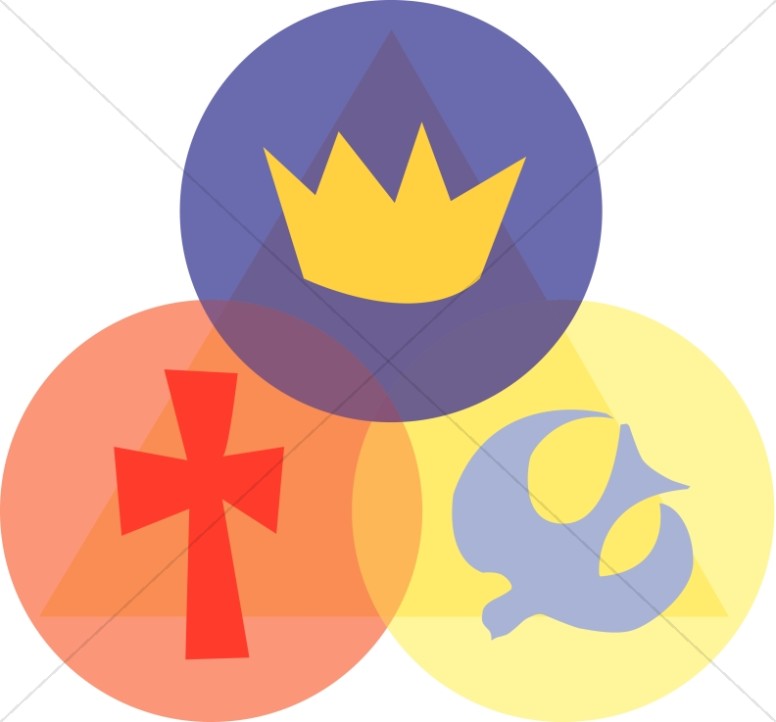
Trinity with Crown, Cross, and Dove (pointing up)And so, dear friends, the three persons of the Most Holy Trinity must inspire also our human society. The Father, the Mother and the Children must live together in unity and peace. The inseparable unity and love of the Trinity has to reflect in our domestic Church. Following this identity of the three, the Church has three hierarchical structures among the clergy: the deacon, the Priest and the Bishop. We must also work hard to reflect the love and unity of the Trinity in this hierarchy by being in one heart and mind with ourselves and with the Church. We must not allow ourselves the joke of not participating to work for an indivisible unity in the Church. It is true that no two persons are the same; but it is even truer that we can live as same. The three persons in the Trinity are distinct persons and this is shown in their function in the economy of salvation (the Father creates, the Son saves and the Spirit sanctifies); yet they are inseparable in their substance and essence. We may be different, but we can understand and tolerate one another.

Gold Trimmed Celtic Trinity Knot
Providentially, our system of Governing has chosen a three dimensional pattern of the Executive, the Judiciary and the Legislature. The question should be constantly asked: how do they work in an incorruptible harmony to achieve oneness and progress in the country? The success of the Trinity cannot ever be over-emphasized. Unity brings forth progress. The onlookers will be overtaken by events that they will ask themselves: when did they achieve all these? If you want progress, seek for unity. The trinity had resounding success in their work of salvation for mankind because of their inseparable unity and love. We can achieve too resounding success if we develop and work for unity in our various areas of human endeavour. May the trinity inspire me; inspire you and inspire all of us. I wish you a blessed week ahead. God bless you.

Welcome!!! We are here for your joy and wellbeing. Fr. Ezekoka prays for you.

EMBRACNG THE OPPORTUNITY OFFERED BY PENTECOST

  HOMILY FOR PENTECOST (YEAR B) Acts 2:1-11        Galatians 5:16-25        John 15:26-27; 16:12-15 Pentecost is the fiftieth day ( Πεντηκοσ...