Friday, 9 December 2016

HOW CAN WE LOOK FOR ANOTHER? YOU ARE HE.


HOMILY FOR THE THIRD SUNDAY OF ADVENT, YEAR A

Rev. Fr. Ezekoka Peter Onyekachi
The woman said to him: I know that Messiah is coming (he who is called Christ). When he comes, he will tell us all things. Jesus said to her, I who speak to you am He (John 4:25).


All of us at one time or another has had one expectation or another from the Lord. Some of us have really felt great disappointments when our expectations are not met. Some have lost the love and friendship they had with some others due to series of disappointments. Some have also felt scandalized about the actions of people they hold at great esteem. Some have actually felt displeasure concerning the dispassionate attitudes many people they expected fine treatment from have shown them. These are the kinds of thought that may come into the mind of a Christian who encounters today’s Gospel message. Some Christians tend to interpret the question of John the Baptist as a question of an unbeliever or someone who is unsure of Christ. Some commentators have also backed this kind of idea with the response of Christ about John when he said that he is the least in the kingdom of heaven, advocating that it was a message that portrayed Christ disappointment with John. But I tell you, the passage was mainly about the Messiahship of Christ and not about John’s question. The goal of the question is to lead the reader to the discovery of the mission of Christ and thereupon to unequivocally believe that Jesus is the Messiah. This is the intention of the Matthew. Yes, Jesus is the Messiah.

In the Gospel Reading of today (Mtt.11:2-11), we encounter in the very first sentence this question from John though his disciples to Jesus: are you he who is to come, or shall we look for another? John was in the prison and already was a dying man. There would be nothing to make his happiness greater than confirming that the person he introduced as the Messiah (Mtt. 3:1-17) was at his best. The Messiahship of Jesus would render the most ample meaning to the forerunning of John. If Jesus were not to be the Messiah, then John’s forerunning would have been in vain. If Jesus were not to be the Messiah, then John’s imprisonment and death would be very frustrating to John Himself. John needed to confirm his mission; for in confirming his mission can he be more formidable and decisive with his message for repentance which actually sent him to jail. If Jesus had answered John that he was not the Messiah, John would have immediately rushed to Herod to plead for mercy, because nwa o biara iku anwuola (i.e, if the goal is shattered, the work is frustrated). Hey! Who really knew the happiness in John for such answer that was given by Jesus? Many times, we need the confirmation about the mission of others to render our own mission meaningful. We need the knowledge of others to acquire more solid and formidable knowledge. The questions that we ought to ask God and the Church must have the sole intention of an increment in faith and the solidification of our Christian lifestyle here on earth.

It is best to inquire about any person from the particular person about which the inquiry is made. To inquire about Jesus, go to Jesus. To inquire about Christianity, become a Christian. Asking another person can make or mar the intention for which you inquire. When someone offends you as a Christian, do not go around telling everyone you see. Learn to go to that particular person whose acts offended you and ask for an explanation. Yes, it is a really hard thing to do, but wise men do it. You run away from gossip, from rancour, from acrimony and from hatred. You will be clarified and will be far from frustration and disappointments. When you think the owner of your destiny (God) has disappointed, why not go to him; and not to places that may not provide you with the most credible answer? Yes, Jesus is the Messiah.

A trial will convince you. The question of John too, as some have argued may not be for the sake of John himself but for the sake of his disciples. It is very probable that when John and his disciples talked in the prison, the disciples questioned whether Jesus was really the Messiah. John’s answer could have been: if any of you has doubts, let him go and ask Jesus himself. This means that if anyone begins to argue with us about Jesus, and to question his kingship, the best of all answers is to say: give your life to Jesus, and see what he can do with it. The supreme argument for Christ is not intellectual debate but an experience of his changing power.

Jesus’ answer confirmed his mission. He outlines the liberating works of the Messiah as foretold by the prophets. There is liberation for those who are captives of one natural or physical ailment. God himself is the saviour. Indeed, this is the message of the First Reading of today from the oracle of Isaiah 35:1-6a.10. When the king comes, there must be liberation, testimonies, happiness, joy, thanksgiving, and their likes. Yes, Jesus is He who comes.

Action speaks louder than words. Jesus’ answer goes straight to his action and not his words. To be candid, the world today needs more doers of the Gospel message than preachers. Our actions confirm our Christianity, not merely our words. In this case, Jesus demands that he be judged by his deeds. Can you be judged by your deeds? Can you leave the comfort of your home and help the struggling brethren out there? It is in our sacrifices that we are edified.

Jesus spoke about John with a high sense of admiration. His questions portrayed John as an extra-ordinary man who was sought after for the rare gift he possessed, as a spiritual man who was neither materialistic nor moved by the things of this world, as a preacher of the word who was solely interested in the repentance of the people, as more than a prophet who showed the people the God-man. John was more than a prophet about whom other prophets spoke of (cf. Mal. 4:5, Behold, I will send you Elijah the Prophet, before the great and terrible day of the Lord.); and no man could have a greater task than this. John was a herald of God. He is indeed the greatest of all the prophets. Little wonder Jesus states that among those born of women, John was the greatest. But why is the least in the kingdom of heaven greater than John?

Jesus is the kingdom of God Himself. In him is the kingdom of heaven. He is the auto-basileia.to experience Christ is to experience the kingdom of heaven. To be with Christ is to be with the kingdom. To know Christ is to know the kingdom. To preach Christ is to preach the kingdom. This is exactly what Christians have that John never had. He pointed Jesus to the people as the Messiah but never did he experience and knew Christ very closely while on earth. He was like a sign post pointing towards the destination (Christ). Hence, it is logical that those who enter the destination have more knowledge and experience than the person who points to the destination. The signpost does its work so well. That is why it can be regarded as the best leader towards the destination. However, its destiny to be the signpost has rendered its experience of the destination insufficient, whereby the persons who enter come out with a greater knowledge. John sowed Jesus to the world, but could not experience his Messiahship and his redemptive acts on earth. The apostles and the Christians were privileged to experience Christ, and to see and hear what the prophets all dreamt to have but never had. In other words, Jesus may have been inadvertently saying: John could have prophesied about my coming and pointed me as the messiah, but there are those who will preach me to the whole world, make converts, live holy lives for my sake and die for me. These people are greater than John even though John is the greatest of the prophets before him.

We have all been giving this opportunity to be great in heaven and to proclaim the king who is coming. As a Christian, grab the opportunity now, and never be weighed down by troubles and tribulations. I thus conclude with the admonition of James to all Christians (James 5:7-11, the Second Reading): Be patient and wait until the Lord comes. Do not be worried by the uncertainties of this life. Do not grumble at your various disappointments in life. Be patient just like the farmer who waits until the crop is fully watered by the rains of heaven. Yes, He is coming. Jesus is the Messiah that comes. We shall not wait for another. I wish you a blessed week ahead. God bless you.

Friday, 2 December 2016

REPENT AND PREPARE THE WAY FOR THE KING


HOMILY FOR THE SECOND SUNDAY OF ADVENT, YEAR A
John preaches, ‘Repent, for the Kingdom of heaven has come near.’ – Slide 3
Rev. Fr. Ezekoka Peter Onyekachi

It is a generally recognized courteous act to prepare and clean one’s house when he/she notices or gets some form of information that a distinguished friend (or a visitor) is coming to his home. Everyone at home is busy, some sweeping and mopping, some cooking, and some arranging the home gadgets and keeping them at their proper places. This is the first sign of a warm welcome that any person can give to a visitor. When this visitor arrives, and notices that the household prepared for his/her visit, he/she feels honoured and at home. Indeed, since the warm welcome has begun before his arrival, the visitor cannot but experience the aura that preceded his coming. The word repent has to do with a change of mind while the word prepare has to do with a change of action. Conversion starts from the mind, and showcases itself in the action. You cannot sincerely demonstrate an acceptance of someone in the act unless you had welcomed him/her in the mind. These are the two keywords which form the corner stone of my reflection today.

METANOIA (REPENT!!!)
Repentance denotes the condition of being sorry for something, a feeling of regret or remorse for doing wrong or sinning and a sense of pain and sorrow for what one has done or omitted to do. This is a general understanding of this word. Beyond all this, there is a foundational root out of which these illustrations are made. The verb used in the Gospel passage today in its original language (Greek) is metanoein which is of course in its imperative mood. The Gospel Reading (Mtt. 3:1-12) exposes the fore-running of John the Baptist and his message of repentance and preparation. The Evangelist narrates that John was preaching in the desert: repent for the kingdom of God is at hand. From the Greek word, metanoia, to repent simply denotes a change of mind. Repentance does not end in a feeling of guilt or in being sorry for one’s sins. It is repentance when there has now been a change of mind: from thinking evil to thinking good, from suspecting to trusting, from scepticism to surety, from segregation to congregation, from individualism to community, from atheism (the belief that God does not exist) to theism, from insincerity to sincerity, from pride to humility, etc. Yes, these are the signs of a change of mind.

Our change of mind must initiate the mentality that sees everyone as equal, one that accepts all irrespective of our cultural differences, ethnic groups, different ideologies, racial discrepancies, etc. To say you have repented, one must regard evil as evil and regard good as good. One cannot regard evil as good or good as evil, and still brag to be a repentant person. The repentance of the thief at the side of Jesus started when he saw the innocence of Jesus, and changed his mind (as against the other thief) about the suffering of an innocent man. Peter’s repentance started when he remembered Jesus’ prediction of the denial and wept bitterly (Mtt 26:75); this change of mind reflected in the manner he carried out the rest of his apostolate. John was calling for a change of mind when he told the Pharisees and Sadducees not to presume that they have Abraham as their father. If they are able to change their minds about such thinking, the journey of their repentance has started.

The message that followed the call for repentance in the mouth of John is the kingdom of God is close at hand. The kingdom God is at the heart and centre of Jesus message of salvation. The words were on the lips of the evangelists: “the time is fulfilled, and the kingdom of God has come near” (mark 1:15); but if it is by the finger of God that I cast out the demon, then the kingdom has come upon you (Luke 11:20), “the kingdom of God is not coming with things that are observed; nor will they say, look, here it is or there it is for in fact the kingdom of God is among us (Luke 17:20-21); from the days of John the Baptist until now the kingdom of God has suffered violence and the violent take it by force (Matt. 11:12). This kingdom of God is meant to stand for two things in our lives today:
1.    
 The kingdom of God is a saving event for sinners, not a judgement of vengeance on sinners and godless men. God’s mercy and forgiveness are preached to all and are made visible in Jesus’ actions: the revelation of God’s love for sinners is a sign of the coming reign of God. Thus, the nearness of the kingdom of God urges us to repent and eschew from us all those sins that make us shy away from God.
2.     The kingdom of God demands a radical decision for God, not a demand for men to follow a new, improved moral code. It must be either God and his reign or the world and its reign, no two ways about it. Repentance (metanoia) is involved which is made possible by faith. It is the necessary and fundamental condition of entry into the reign of God – Repent and believe in the Gospel (MK 1:15). The changing of our minds must be seen in our belief in the good news of Jesus Christ.

PREPARE THE WAY
The Evangelist immediately makes a link to the oracle of Isaiah: prepare the way of the Lord, make his paths straight. John is the one for whom Isaiah spoke, says Matthew. This oracle of Isaiah was one that was meant to console the people during the post-exilic moment when there was seemingly no hope. It was a message that exhorted the people not to give up, but to stand erect and start preparing for that king who is coming to bring total restoration to them. There was a detonation (an instantaneous explosion that causes destruction and brings about shocks) in the entire experience of the people, and so was the need for restoration. There may be detonation, but Restoration must follow it. Our preparation is channelled towards this restoration. If you do not prepare, you will not be restored. We must prepare the way for the king who comes. John the Baptist announces this way (Mark 1:3), and Jesus declares that he Himself is the way (John 14:6). Christianity can thus be regarded as the way. She is the way that connects you with the kingdom of God. She is the way that beckons on you to bear fruit that befits repentance.

Preparation involves action, for action speaks louder than words. It is preparation when it flows from repentance, and not a mere ostentatious manifestation; from favouritism of some to treating everyone as one; from war to peace; from doing evil to doing good; from licentiousness to continence, from lust to love,  from hard-heartedness to perfect contrition; from stinginess to charity; from bad words to good/kind words, etc. Our preparation must initiate the actions that can sweep out the evils in our society, and can decorate and adorn it with perfect virtues of Jesus Christ. Our preparation must be one that will never allow us to give up on the insistence on the truth, and on persistence on the good. It must annihilate the injustice and vices that are eroding the world today. This preparation must come with it a break-away from the evil alla mode. Having killed evil and strife, it initiates a new good thing.

The First Reading (Isaiah 11:1-10) relays the apparently impossible experiences that come with the dawn of the King. After the king has judged with righteousness and not by appearances or hear-says, there will be a totally peaceful world that is allegorically represented in the form that wild animals that prey on one another will turn to be peaceful with themselves. There will be no longer fear as no one will be a wolf to the other; animals will no longer attack men and children will no longer be afraid of them. All these are possible because they dwell in the holy mountain of God. Yes, in His days, justice shall flourish and peace till the moon fails. To repent is a good. To prepare for the Lord is a good. May our repentance be in-depth, and may our preparation be one that will gladden the king. I wish you more and more blessings this Advent. Happy New Week; God bless you.

Friday, 25 November 2016

BE WATCHFUL FOR THE COMING OF THE KING


                           HOMILY FOR THE FIRST SUNDAY OF ADVENT, YEAR C
Rev. Fr. Ezekoka Peter Onyekachi

A story is told of three demons who were coming to the earth to deceive men and lure them to Satan, their chief. They were seeking advice from Satan about their plans to tempt and ruin men. The first said, “I will tell them that there is no God.” Satan laughed and said: “that will not deceive many for so many have experienced God in their lives.” The second said, “I will tell them that hell does not exist, so that they can live they way they want.” Satan again laughed even more and said: “men know that there is always a punishment when there is an offence. They will never believe that there is no hell.” The third then said, “I will tell men that there is time; that they should relax and not be in a hurry, for there is always a tomorrow.” The devil smiled to him and said, “go, and you will deceive many by their thousands.” Hey! The most dangerous of all delusions is that there is plenty of time. There is a word known as procrastination. It is a killer of time. It is an unnecessary postponement of programmes which in actually could be done at a time before the scheduled date it has been postponed.
The Gospel Reading (Mtt 24: 37-44) spells it out very vividly how we ought to be constantly prepared and not be deceived by those who may tell us that they know the hour of the coming of the Lord. The danger that lies in such a claim is that the people are rendered lazy in their struggle for heaven. If they know the hour, it is consequential upon man to relax, only to wait for the dawn of the coming to get prepared. We must remember the parable of the foolish and wise virgins. It is therefore clear that speculation regarding the time of the second coming is nothing less than blasphemy, for the man who speculates is seeking to wrest from God secrets which belong to God alone.
We must be careful when we notice ourselves immersed in materialism. It is in such an immersion that we can tend to forego God, and so that time will come with shattering suddenness. Jesus made reference to the story of Noah. Noah prepared himself for the flood and was saved, but others were giving in marriages and feasting and were lost. They allowed the activities of this life (however necessary) to rip them of the activity of heaven. We must never be so immersed in the things of this life that we forget eternity. We need to be found ready at any time, the Lord demands our attention.
To live without watchfulness is a disaster. The weapon of the thief is surprise; and thus, a householder must be constantly on watchful guard against such invasion. The Christian must be watchful with eager expectation for the coming of the Lord who comes with glory and joy. That is what advent season tells us. To make ourselves ready and with eager expectation wait for the coming of the king. The spirit which leads to disaster is that he says that there is plenty of time. Going back to our lead story, whenever we allow ourselves to be convinced that there is plenty of time, it is then that we deceive ourselves. There is no greater deception than the one that delays appropriate preparation for God’s entrance into our lives, or the one that convinces oneself that there can be conversion tomorrow, and not today. There are practical relevancies that the coming of the king must teach us:
1. No one enjoys a person who does not keep to time. How do you feel when someone gives you an appointment, and he/she is late, or worse still fails? How do you feel when a particular worship time is fixed, and the celebrant is late? How do you feel when as a boss, you give your worker some work to do, and then the work is not done, or there are 101 excuses for not meeting up with the time? I once gave my student a punishment to write an article on Procrastination because of the delay manner he carried out his work. After researching and writing the article which he did so well, he told me that it really helped him to know the dangers of postponing things. He wrote well on its dangers. He posits that procrastination leads to doing the right thing at the wrong time. Yes, I agree with him. There is time for everything. A foolish student may decide not to study during the lecture period or the preparatory classes, and decides to study in the midnight when others are sleeping, and by so doing distracts others. Procrastination not only affects the person who procrastinates, but others around.
2. Procrastination manifests unseriousness. When we procrastinate, we are showing unseriousness in our faith, and so project ourselves as unserious people. Many of us postpone conversion. We postpone charity and good works. We postpone prayer time. We postpone peace and unity in our families and communities. See, let me tell you: by the time you know, we are overtaken by events. We do not know the hour that God comes. Only God alone knows. We must run as far as our legs can carry us away from postponing any good work or spiritual lifestyle that we desire. The king must come; but we do not know the hour that he comes. We must be watchful and vigilant so that we can never be found wanting when our king comes. We must live each day knowing that our salvation is nearer to us than when we first began to believe (cf. Second reading: Rom. 13:11-14a).
3. Those who think that there is time are lazy with work. They continue to postpone when to submit their CVs (Curiculum Vitae). They continue to convince themselves that no one can take their place. They are liable to align themselves with the saying that destiny can be delayed, but not denied; and so even if they delay, what will be, will be. They are the ones that will tell you that their positions and connections must wait for them; that even if out of their delay, they miss the opportunity, that it was not ab initio meant for them. I pity these people who believe that there is time. They go with such words: let us relax and merry now for there is tomorrow. The hard truth there is that tomorrow may not actually come; today can be your last. Why not make the decision and act today? Why must you wait for tomorrow to execute what you can achieve today? Why not decide to write JAMB this year, and not wait for next year? Why must you wait for next year to take loan from bank for your business? Why must you wait until you are 30 to further your studies? Why must you wait for examination period to come before you start studying as a student? Make haste while the sun shines.
4. In Politics, we see the attitude of laziness and postponement of work. A leader thinks and executes in time. However, our leaders think, talk, and execute outside of time. Some of their policies and actions appear atemporal. The way they lead appears to me that they think they have eternity to fix things up. Why not start today to construct that road that has become a death trap to your people; they prefer to wait until accident occurs therein? Instead of waiting for the next election, why not achieve and execute your campaign promises in the present tenure? I pity those Nigerian politicians that are already talking about 2019 Elections, where we know that they have done practically nothing in the present tenure. This is heartlessness. People are crying, lamenting, dying out of frustration and poverty; dying out of their inability to give themselves proper health check-ups; dying out of the uneasiness to feed properly; dying out of the stress imposed on their health due to the present condition of the country; and all a leader could do is to talk about the next election. Woe to such a leader! For me, the beast is better than he. To such people, I say: time waits for no man. Nigerians can never wait for you; they can never wait for the next election. Indeed, that next election will even be your doom. Nigerians are ready to expunge and send all of you packing out of those positions. The children of God must be free. We must enjoy what God has given to us, both here on earth and hereafter in heaven.
I therefore urge you, my dear friends to be more watchful for the coming of the king, our Lord Jesus Christ through the way you lead your lives, as I pray God to remove from you the spirit of delay and laziness and bestow on you the spirit of agility and alacrity. You must be a young achiever. You must be a young graduate. You must be a young millionaire. You must be a young doctor (or any discipline of your choice). You must be a young bride. You must be a young groom. Indeed, you must be a listener and doer of the gospel message of our Lord Jesus Christ. I wish you more blessings ahead, and a blessed week. I wish you a favour-filled Advent season. A new year of the Church has just begun. Make use of it now that you can to turn a new leaf. God bless you.  

Friday, 18 November 2016

JESUS, THE KING OF MERCY


HOMILY FOR THE SOLEMNITY OF CHRIST THE KING, YEAR C
Rev. Fr. Ezekoka Peter Onyekachi

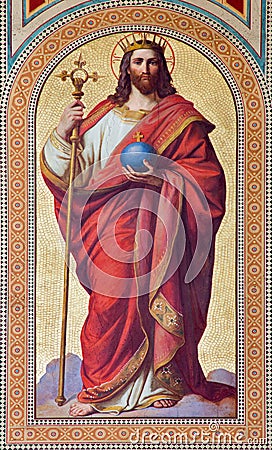
Vienna - Fresco of  Jesus Christ as King of the World by Karl von Blaas from 19. cent. in nave of Altlerchenfelder church
The Lord has established his throne in heaven and his kingdom rules over all (Psalm 103:19)


As the second person of the Trinity, the eternal son, Christ naturally shares the dominion of God over all. This is a kingship exercised by Christ in His divine nature. However, there is also another type of kingship which is a conferred (cf. Luke 22:29: and I confer upon you a Kingdom, just as my father conferred one on me) and economical kingship exercised by Christ in His nature as Theanthropos (the God-man). This is the mediatorial kingship of Christ. This is the official power of Christ to rule all things in heaven and on earth, for the glory of God, and for the execution of God’s purpose of salvation (it is here that we encounter Christ as the king of mercy). It is inside this mediatorial kingship of Christ that we can comfortably dwell on the regnum gratiae and the regnum potentiae.
THE REGNUM GRATIAE (the Kingdom of grace)
Christ rules over the regnum gratiae. This is a rule established in the hearts and lives of believers. It is a rule that bears directly to the spiritual end of man –salvation. It is administered not by force or external means, but by the word and the spirit, which is the spirit of truth and wisdom, justice and holiness, grace and mercy. This kingship reveals itself in the gathering of the church, and in its government, protection and perfection. And because of these, it is a spiritual kingship because of its relevance to the spiritual realm. It is this kingship for which the Psalmist prays: Your throne O God will last forever, a sceptre of justice will be the sceptre of your kingdom (Ps. 43:6; cf. Heb. 1:8, 9). It is of this rule that the prophet Isaiah says: to us a child is born, to us a son is given. He will be called wonderful counsellor, mighty God, Everlasting Father Prince of peace; of the increase of his government and peace, there will be no end (Isaiah 9:6). And the Prophet Micah says: But you, Bethlehem Ephratah...out of you will come for me one of you who will be ruler over Israel, whose origins are from old, from ancient times. The Lord will give him the throne of his father David, and he will reign over the house of Jacob forever, his kingdom will never end (Luke 1:33).
The spiritual nature of this kingship is indicated by the fact that Christ is repeatedly called the head of the Church (cf. Eph 1:22; 4:15; 5:23; Col. 2:19). Head in a figurative sense indicates one clothed with authority. In the Second Reading of today (Col 1:12-20), Christ is called the head of the body the Church. This is used in its organic conception (as the chief and most important part of the human body). It is because Christ is the head of the Church that He can rule it as king in an organic and spiritual way. He reconciles to himself all things, making peace by the blood of his cross. He is the king of mercy. A merciful king reconciles and makes peace. These are the prominent demonstrations of a merciful king; this is what Christ is. If you believe in Christ kingship of mercy, then you will not get tired of approaching his throne of mercy as a Christian. So many times, we find it hard to ask God for forgiveness or to go to the sacrament of confession. We are demoralized by the fact of a sin that we repeatedly do, even when we have confessed it over and over again, and have made a firm purpose of amendment. Do not give up, for you have a king of mercy that is willing to accept you, and cleanse you from your sins. Come now, let us reason together, says the Lord. Though your sins are like scarlet, they shall be as white as snow, though they are red as crimson, they shall be like wool (Isaiah 1:8).
This spiritual kingship of Christ has the following characteristics:
·       It is grounded in the work of salvation: the regnum gratiae originates in the redeeming grace of God. This citizenship of this kingdom is not automatic; for no one gains membership in virtue of his/her humanity. Only those who accept the kingship of Christ have that honour and privilege. Christ paid the ransom for those that are His. Consequently, they now recognize Him as their Lord and King. This is exactly what happened in the Gospel of today (Luke 23:35-43). The thief who recognized the innocence and the kingship of Christ was saved. This is evident in his words: but his man has done nothing... Jesus, remember me when you come in your kingly power (Luke 23:41.42). If we recognize Jesus as our king, his merciful nature overshadows us.
·       It is spiritual: the spiritual nature of this kingship is seen in its all-inclusive character. No one is excluded. It is clear that the kingdom is not an external and natural kingdom of the Jews. I say to you that many will come front the east and from the west, and will take their place at the feast with Abraham, Isaac and Jacob in the kingdom of heaven (cf. Mtt 8:11.12). It can only be entered by regeneration. They are the poor in spirit, the meek, the merciful, the peacemakers, the pure in heart, and those that hunger and thirst for righteousness. It is in the hearts of people (cf. Luke 17:21), and a kingdom of truth (Cf. John 18:36-37). Have you been regenerated? We must, as Christians allow these virtues to be planted in us by the Church that we may become the sons of the kingdom.
·       It is both present and futuristic: the kingdom eventually consists in the present reign of God in the hearts of men, but at the glorious coming of Jesus Christ this establishment will be perfected, and the spiritual rule of Christ will find its consummation in a visible and majestic reign. Yes, it will be majestic and great signs will accompany the coming of the Lord. But the day of the Lord will come like a thief. The heavens will disappear with a roar, the elements will be destroyed by fire, and the earth and everything in it will be laid bare (cf. 2 Pet 3:10-12).
·        It is closely related to the Church: the kingship of Christ is identifiable with the visible Church. That is why we celebrate Christ as king. He is our king. We are his people. Heaven and earth are the expanse of his kingdom. Surely, Christ will never cease to be the head of the Church, leaving the Church as a body without the head.
THE REGNUM POTENTIAE (the kingdom of dominion)
Christ exercises dominion over the universe. He providentially and judicially administers all things in the interest of the Church. He guides the destinies of individuals, of social groups, and of nations, as to promote the growth, the gradual purification, and the final perfection of the people which He has redeemed by His blood. He protects His own against the dangers to which they are exposed, and vindicates his righteousness by the subjection and destruction of all His enemies. This kingship supersedes all earthly kings, and is there to humble them against pride and subjugation of the people they lead. The king of mercy rules in mercifulness, humility and love. He is there as a proto-typical king for the human rulers and kings.
The First Reading (2 Samuel 5:1-3) was explicit on the human lineage of Christ as the king. David was anointed king over all Israel. His kingdom, great and powerful, became the symbol of the kingdom of peace and justice that God would one day establish on earth. Hence, the Davidic kingship became the lineage that extended to the kingship of Christ. The Davidic kingship was so cherished by God that “the Lord swore an oath to David, a sure oath that he will not revoke: one of your own descendants I will place on your throne” (Ps. 132:11).
The dominion kingship of Christ has the following characteristics:
·       Its power and authority are non-negotiable: the kingship of Christ stands as the most powerful. Its authority is binding on all men as Christ forever is the king of the universe. Our belief or doubt of this kingship does not remove or add anything. Christ is king irrespective of human acceptance. Pilate unequivocally stated: Jesus of Nazareth, the king of the Jews (cf. John 19:19).
·       Its dominion over the evils of the society is clear: David was anointed king after having defeated all his enemies. Jesus, the son of David and the king of mercy also destroyed completely the power of Satan in the lives of men. Satan has no power again. There is now no condemnation for those who are Christ Jesus, because Christ has liberated us and given us strong antidotes against evil. By the name of Christ Jesus, every knee must bend (Philipians 2:10).
·       It is a kingship of one kingdom: this kingship is one that is all-embracing; bringing all the nations as one. Unlike the nations of the world that have their different kings, Christ is the king of all the nations. In this sense, he is above every king; seen and unseen. All things, in heaven and on earth is under one head, the Christ (cf. Phil 1:10).
It is incumbent on Christ as the anointed Christ to establish the kingdom of God, to govern it, and to protect it against all hostile forces. He must do this in a world which is under the power of sin and is bent on thwarting all spiritual endeavours. If that world were beyond Him, it might frustrate all His efforts. Therefore, God invested Him with authority over it, so that He is able to control all powers and forces and movements in the world, and can thus secure a safe footing for His people in the world, and protect His own against all the powers of darkness. These cannot defeat his purposes, but are there to serve them.
Today, we proclaim Christ as the king of mercy; mercy which has been a term in our mouths since the beginning of this liturgical year. We must thus proclaim Christ as the king of mercy. It is in this line that I invite all of us to herald the king of kings and exclusively call out to him as the KING OF MERCY. This week, I wish you a great visitation from this king of mercy. God bless you.
 

Welcome!!! We are here for your joy and wellbeing. Fr. Ezekoka prays for you.

EMBRACNG THE OPPORTUNITY OFFERED BY PENTECOST

  HOMILY FOR PENTECOST (YEAR B) Acts 2:1-11        Galatians 5:16-25        John 15:26-27; 16:12-15 Pentecost is the fiftieth day ( Πεντηκοσ...